Choosing the right Aluminum Cosmetic Bottles can shape a product’s safety, appearance, and wholesale performance. Buyers are no longer judging packaging by shine alone. They inspect material quality, closure fit, filling compatibility, decoration accuracy, and delivery reliability.
Charles Johnson, President and CEO of The Aluminum Association, has stated, “Aluminum can be recycled over and over again without losing its properties.” This principle matters in cosmetics, where durable packaging must also support responsible resource use. However, recyclability should not become a marketing shortcut. Buyers still need verified material information, suitable coatings, and dependable manufacturing records.
This 2026 guide examines the best Aluminum Cosmetic Bottles for wholesale buyers. It focuses on practical details, including bottle capacity, aluminum grade, wall strength, valve or pump compatibility, inner lining, and surface finishing. A bottle may look premium under showroom lighting, yet fail during filling or transit. Small dents, loose pumps, uneven printing, and inconsistent neck dimensions can create expensive problems.
Real testing matters.
Wholesale evaluation should include sample approval, compatibility checks, leakage testing, and production inspections. Buyers should also confirm minimum order quantities, mold charges, lead times, customization options, and replacement policies. Sustainability claims deserve careful review, especially when coatings, mixed components, or difficult-to-remove pumps affect recycling outcomes.
There is no perfect bottle for every formula or market. That is the uncomfortable part. The strongest choice balances protection, visual identity, cost, and supply stability. This comparison is designed to help buyers make that decision with clearer evidence and fewer assumptions.
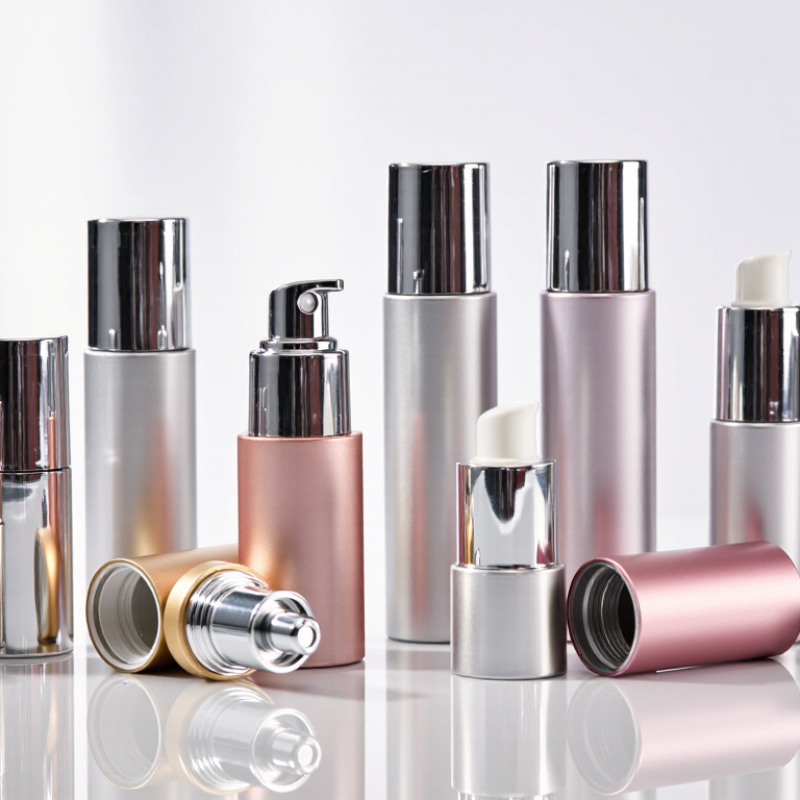
Aluminum cosmetic bottles come in several practical forms. Common options include pump bottles, spray bottles, squeeze bottles, and screw-cap containers. Each design supports a different product texture and dispensing routine.
Pump bottles suit lotions, liquid cleansers, and lightweight creams. Spray versions work well for facial mists, hair care liquids, and refreshing body products. Squeeze bottles offer controlled use for gels and thicker formulas. Some buyers prefer slim travel bottles, while others select wider containers for shelf display.
Aluminum provides a lightweight structure with a premium, cool-touch feel. It also blocks light, which can help protect sensitive formulas from exposure.
Interior coatings are important, especially when products contain oils, acids, or strong fragrances. Compatibility testing should include leakage, odor transfer, corrosion, and repeated pumping. A bottle may look excellent but perform poorly with the wrong closure.
Details matter. Neck size, dip-tube length, actuator pressure, and cap fit can affect daily use. Color coating and labeling should also withstand handling, moisture, and warehouse movement.
In wholesale projects, these bottles commonly serve skincare, hair care, body care, fragrance, and personal care products. I have found that sample testing prevents expensive packaging changes later.
A slight dent can weaken presentation. A loose pump can create shipment complaints. Not every formula fits.
Buyers should compare filled samples under heat, cold, vibration, and normal consumer use.
My own packaging checks are never perfect, because real handling exposes flaws that specifications may miss. That limitation deserves attention before approving a large production order.
In 2026, aluminum cosmetic bottles remain a practical choice for wholesale packaging. Their low weight can reduce shipping pressure without making the bottle feel fragile. Material choice shapes durability, appearance, and recycling value. Recycled aluminum may support sustainability goals, but its percentage should be verified through supplier documentation. Ask for composition data, wall thickness, and compatibility testing. Do not rely on vague environmental claims.
The finish creates the first physical impression.
Brushed aluminum shows a soft grain and hides minor handling marks. Polished surfaces look brighter but reveal fingerprints quickly. Anodizing can provide color and surface protection, while sprayed coatings offer more shade flexibility. Every finish has limits. Some coatings may scratch during bulk transport.
Closures deserve equal attention.
Choose screw caps for controlled dispensing, pumps for lotions, and fine misters for lightweight formulas. Confirm thread size, seal quality, and torque requirements before placing a large order.
Customization can include screen printing, laser marking, embossing, color matching, and shaped shoulders.
Simple graphics often remain clearer on curved bottles. Metallic inks may appear different under warm warehouse lighting. Request production samples, not only digital drawings. Check leakage after repeated opening, especially when bottles travel through changing temperatures.
A useful sourcing lesson is easy to miss: attractive samples do not always perform well in filling lines.
Ask about filling speed, closure alignment, minimum order quantities, and replacement rates. Small imperfections in color or printing should be defined before approval, rather than argued about later.
Wholesale buyers evaluating aluminum cosmetic bottles in 2026 should examine suppliers beyond attractive catalog photos. Request factory details, production capacity, material specifications, and recent quality records. A reliable supplier should explain the aluminum grade, wall thickness, coating process, and neck dimensions clearly. Ask for samples from different production batches. One sample can hide inconsistencies.
Inspect each bottle under bright light. Check dents, uneven color, sharp edges, loose caps, and scratches around the shoulder. Test the pump or sprayer repeatedly, then observe leakage after storage. Confirm compatibility with oils, alcohol-based formulas, and water-rich products through proper testing. Packaging also matters. Bottles packed with separators usually arrive with fewer surface marks. However, perfect samples do not guarantee perfect bulk orders. This is where my judgment can be too optimistic.
Tips: Compare landed cost, not unit price alone. Include tooling, decoration, caps, cartons, freight, inspection, and possible defect allowances. Ask for a written quotation with minimum order quantities and production lead times. A lower price may reflect thinner walls or weaker coating. Request a pre-production sample before approving mass production. Keep inspection standards measurable, such as acceptable dent size and color variation. Small details prevent expensive disputes.
Wholesale evaluation benchmarks for aluminum cosmetic bottles; figures are indicative planning ranges and should be confirmed with each supplier.
| Evaluation dimension | Typical benchmark | Why it matters | Buyer verification method | Wholesale planning note |
|---|---|---|---|---|
| Common capacity | 30 ml, 50 ml, 100 ml, 150 ml, 200 ml, and 250 ml | Capacity affects product positioning, shipping weight, closure selection, and unit cost. | Request a calibrated volume test and a dimensional drawing. | 50–100 ml sizes are commonly suitable for serums, lotions, oils, and travel-oriented products. |
| Aluminum thickness | Approximately 0.40–0.80 mm for many cosmetic bottle formats | Thicker walls generally improve dent resistance but may increase material cost and weight. | Measure samples at the shoulder, body, and base using a thickness gauge. | Do not compare prices without confirming thickness and total bottle weight. |
| Surface finish | Anodized, powder-coated, lacquered, brushed, or uncoated metal | The finish affects appearance, corrosion resistance, print adhesion, and chemical protection. | Check coating uniformity, color consistency, adhesion, and scratch resistance on production samples. | Custom colors and multi-step finishes normally require higher MOQs and setup charges. |
| Internal coating | Required when the formula may react with bare aluminum | A compatible internal barrier helps reduce corrosion, discoloration, odor transfer, and formula contamination. | Conduct compatibility testing with the actual formula under accelerated and real-time conditions. | The lowest bottle price is not economical if the formula damages the inner surface. |
| Neck and closure fit | Common screw-neck formats include 18/410, 20/410, 24/410, and 28/410; exact specifications vary | A correct neck finish is essential for pumps, sprayers, droppers, disc caps, and screw caps. | Verify neck drawings, thread dimensions, torque, liner fit, and closure interchangeability. | Price the bottle and closure as a tested set rather than as separate components only. |
| Leakage performance | No leakage during agreed inverted, pressure, and transport simulations | Leakage can cause product loss, carton damage, returns, and regulatory or marketplace complaints. | Request a documented leak test using filled, closed production-equivalent samples. | Test with the final formula and closure; water-only testing is not sufficient for every product. |
| Decoration capability | Screen printing, offset printing, hot stamping, labeling, and laser marking | Decoration determines brand appearance, abrasion resistance, color accuracy, and production complexity. | Approve a color proof and decorated sample before mass production. | Ask for separate pricing for artwork setup, plates, samples, and each additional print color. |
| Typical MOQ | Approximately 500–5,000 units, depending on stock status, finish, and decoration | MOQ influences unit pricing, inventory exposure, and the feasibility of custom finishes. | Request MOQ by size, color, finish, closure, and decoration method. | Stock formats may have lower MOQs; custom tooling and colors generally increase them. |
| Indicative unit price | About US$0.30–US$1.80 per bottle at larger wholesale volumes, before freight and taxes | Price changes with capacity, wall thickness, closure, coating, decoration, order quantity, and tooling. | Compare like-for-like quotations using the same specification and Incoterm. | Treat this as a budgeting range, not a fixed market quotation; request a current written offer. |
| Sampling timeline | Approximately 7–15 calendar days for standard samples; longer for custom decoration or tooling | Fast, controlled sampling reduces the risk of approving an unsuitable package. | Record sample dates, revision numbers, approved specifications, and test results. | Do not approve mass production from an unmarked or non-production-equivalent sample. |
| Mass-production lead time | Approximately 25–45 calendar days after artwork, specifications, and deposit approval | Lead time affects launch planning, replenishment, and safety-stock requirements. | Obtain a production schedule covering materials, decoration, inspection, and packing. | Add time for pre-shipment inspection, export documentation, and international transit. |
| Quality documentation | Specification sheet, material declaration, inspection report, and relevant food/cosmetic-contact information | Documents support internal approval, compliance review, and supplier accountability. | Check document dates, scope, test methods, and whether they apply to the actual component. | Certificates alone do not replace formula compatibility, migration, or performance testing. |
| Pre-shipment inspection | Visual, dimensional, functional, decoration, packing, and quantity checks against approved samples | Independent or documented inspection helps identify defects before goods leave the factory. | Use an agreed inspection checklist and acceptable quality limits before placing the order. | Include defect definitions, replacement terms, and claim procedures in the purchase agreement. |
Aluminum cosmetic bottles can reduce plastic use and support efficient bulk shipping. Their light weight also lowers handling strain during warehouse operations. However, sustainability depends on recycled content, manufacturing energy, transport distance, and end-of-life systems. Ask suppliers for recycled aluminum percentages and credible environmental documentation. A shiny surface alone proves nothing.
Safety requires more than a clean appearance. Product compatibility testing should examine corrosion, color changes, odor, leakage, and coating damage. Acidic formulas, essential oils, and alcohol-based products may stress internal linings. Request migration data, material declarations, and batch-level quality records. Closure integrity testing is equally important during storage and transport. Small leaks become expensive quickly.
Tips: Compare samples after heat, cold, and vibration testing. Confirm the bottle, pump, cap, and liner work as one system. Check applicable cosmetic packaging rules in every destination market, including labeling and restricted-substance requirements. Keep supplier certificates current, because outdated documents can create false confidence. Regulatory language can also vary between regions. A compliant bottle in one market may need additional review elsewhere. No package is perfect, and testing may reveal uncomfortable weaknesses before a large order.
Choosing an aluminum bottle begins with the formula, not the label design. Facial oils and cleansing oils benefit from opaque walls that reduce light exposure. Use a narrow shoulder and treatment pump when controlled dispensing matters. For watery toners, a fine-mist sprayer can improve coverage, but its dip tube needs testing. Thicker serums may need a wider orifice. Small details matter.
Acidic, salty, or high-alcohol formulas can interact with bare aluminum. A suitable internal coating helps separate the product from the metal surface. Request compatibility data, then run filled samples through heat, cold, leakage, and drop tests. Check odor, color, viscosity, and pump output after storage. A bottle that passes one week may fail after several months. That risk is easy to underestimate.
Wholesale buyers should match bottle size to real usage, not only shipping cost. A 30 ml bottle suits concentrated serums, while 100 ml formats fit body oils or cleansers. Confirm neck dimensions, closure torque, liner material, and decoration durability before placing a large order. Ask for batch samples and written specifications. In practical production trials, over-tightened pumps have caused slow dispensing and cracked collars. We also found that thin walls dent more easily during warehouse handling. That is not a failure of aluminum itself, but a packaging decision worth reconsidering.
Choosing the best aluminum bottle size depends on the cosmetic product, usage frequency, and retail format. The chart shows practical fill-volume choices commonly used for wholesale cosmetic packaging.
Smaller bottles are suitable for travel, trial, and premium concentrated products, while 250–500 mL formats are generally more appropriate for daily-use body, hair, and household personal-care products. Final specifications should be confirmed with the filling and closure requirements of each formula.
Common types include pump, spray, squeeze, and screw-cap bottles. Pump bottles suit lotions and liquid cleansers. Spray bottles fit facial mists and hair liquids. Squeeze bottles provide better control for gels and thicker formulas.
Slim bottles are convenient for travel bags and small shelves. Choose a secure cap and compact shape. Test the closure carefully. A beautiful travel bottle can still leak.
Aluminum is lightweight and has a cool-touch, premium feel. It blocks light from reaching sensitive formulas. This may help reduce light-related formula changes. The protection is not automatic.
Interior coatings help separate the formula from the metal surface. They matter more with oils, acids, alcohol-based formulas, or strong fragrances. Test for corrosion, odor transfer, and formula changes. One coating may not suit every product.
Request filled samples from different production batches. Test pumping, spraying, leakage, odor, and cap fit. Store samples in heat and cold conditions. Add vibration and repeated consumer use. Real handling finds problems specifications may miss.
Inspect bottles under bright light. Look for dents, scratches, sharp edges, uneven color, and loose caps. Check the shoulder area carefully. Small defects can weaken shelf presentation.
Neck size, dip-tube length, actuator pressure, and cap fit all matter. A short dip tube may leave product inside. A stiff pump can frustrate users. These details deserve practical testing.
Compare landed cost instead of unit price alone. Include tooling, decoration, closures, cartons, freight, inspection, and defect allowances. Ask for minimum quantities and production lead times. A lower price may mean thinner walls or weaker coating.
No. Production batches can vary in color, coating, and surface condition. Packaging with separators may reduce scratches during transport. My judgment can be too optimistic. Keep measurable inspection standards before mass production.
This guide to 2026 Best Aluminum Cosmetic Bottles for Wholesale Buyers explains how Aluminum Cosmetic Bottles can support modern packaging needs across skincare, haircare, fragrance, and personal care products. It reviews common bottle types, sizes, shapes, wall structures, and dispensing formats, while highlighting important choices such as aluminum grades, protective linings, surface finishes, closures, pumps, sprayers, and customization options. Buyers will learn how packaging design can influence product protection, usability, appearance, and shelf presentation.
The article also provides a practical framework for evaluating suppliers, including manufacturing consistency, sample approval, quality control, production capacity, lead times, minimum order quantities, and wholesale pricing. It discusses sustainability advantages, recyclability, product compatibility, safety testing, labeling, and applicable regulatory requirements. Finally, it compares bottle considerations for liquids, creams, oils, lotions, and other cosmetic formulas, helping wholesale buyers select durable, attractive, safe, and cost-effective packaging for different product applications.

Sunrise Cans